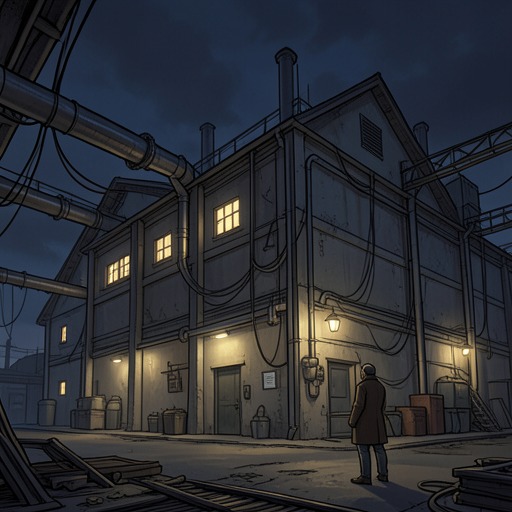
“A road is as strong as its weakest link”
Earth Abides“A road is as strong as its weakest link” is Ish’s compact formulation of a principle that the novel repeatedly demonstrates: a system can appear sound while depending on a vulnerable part that no one remains to maintain. First prompted by a storm-damaged road, the expression gathers weight as Ish encounters the same pattern in the infrastructure left behind after the disaster.
The Road Near Oatman
After passing the summit above Oatman, Ish comes upon a partial blockage caused by a desert storm. Water has plugged a culvert and carried sand across the pavement; beneath the road, it has already washed away half a foot of supporting earth. The damage is not yet enough to stop him. He drives across the sand, but sees how later storms could deepen the erosion until the concrete cracks and more sand and gravel accumulate.
In ordinary times, a road crew would clear the sand and reopen the culvert. Now that routine intervention will not come. Ish thinks, “A road is as strong as its weakest link,” and wonders how long travel by car will remain possible. The road’s weakness is not simply the storm or the culvert: it is the absence of the workers whose maintenance once kept small failures from accumulating.
A Principle Across Systems
The novel extends the idea from a single road to the electric network. The Power-and-Light system continues supplying electricity after its operators fall ill; broken wires and failed power-houses are initially compensated for elsewhere in the network. But the generators depend on governors that require human attention. Their oil is inspected every ten days and replenished when necessary, and after two months without care the supplies dwindle. As governors fail one by one, generators drop out and the remaining units bear an increasing strain, turning isolated faults into a cumulative decline.
A clogged drain on San Lupo Drive offers the same lesson at a smaller scale. Unswept leaves block a drain-pipe, sending water across the street and over the curb. It crosses the tall grass that had been the Harts’ lawn, seeps under their door, and cuts a small gully through the rose-garden before reaching a storm sewer. Ish could clear the blockage in minutes, but recognizes that countless similar failures are occurring elsewhere. Roads, drains, and walls function only while people keep repairing and cleaning the weak points that weather exposes.
The Water System’s Hidden Flaw
The water supply presents the most prolonged version of the pattern. Within the complex system of dams, tunnels, aqueducts, and reservoirs, one section of steel pipe contains the fatal flaw. Imperfections had been apparent when it was manufactured, but it passed inspection at the end of a workday. The pipe initially functioned; shortly before the disaster, a foreman noticed a slight leak that could have been repaired with a welded patch.
After the disaster, no one passes that way to make the repair. The leak grows gradually, marked for a time by a patch of green where birds and small animals come to drink, while rust and the corrosive action of water continue to eat into the pipe. Elsewhere in the system, water escapes through open faucets, leaking joints, and broken pipes. Heavy rain briefly slows the falling reservoir level, but the midwinter dry spell arrives and the gauge shows only a thin skin of water where the depth had recently been twenty feet.
Meaning and Recurrence
The expression links these examples without reducing them to one dramatic collapse. The culvert’s damage is initially passable; the drain’s blockage is small enough for Ish to clear; the aqueduct leak begins as a trickle. Their danger lies in duration and dependence: damage continues, and the systems have no lasting resilience when routine human care disappears.
By returning to the image of the weakest link, the novel makes infrastructure legible as a network of obligations rather than a collection of durable objects. A road, power grid, or water system may seem to stand on its own, but each relies on maintenance at particular points. Once those points are neglected, local defects spread into failures that reshape daily life and limit what survivors can still use.